
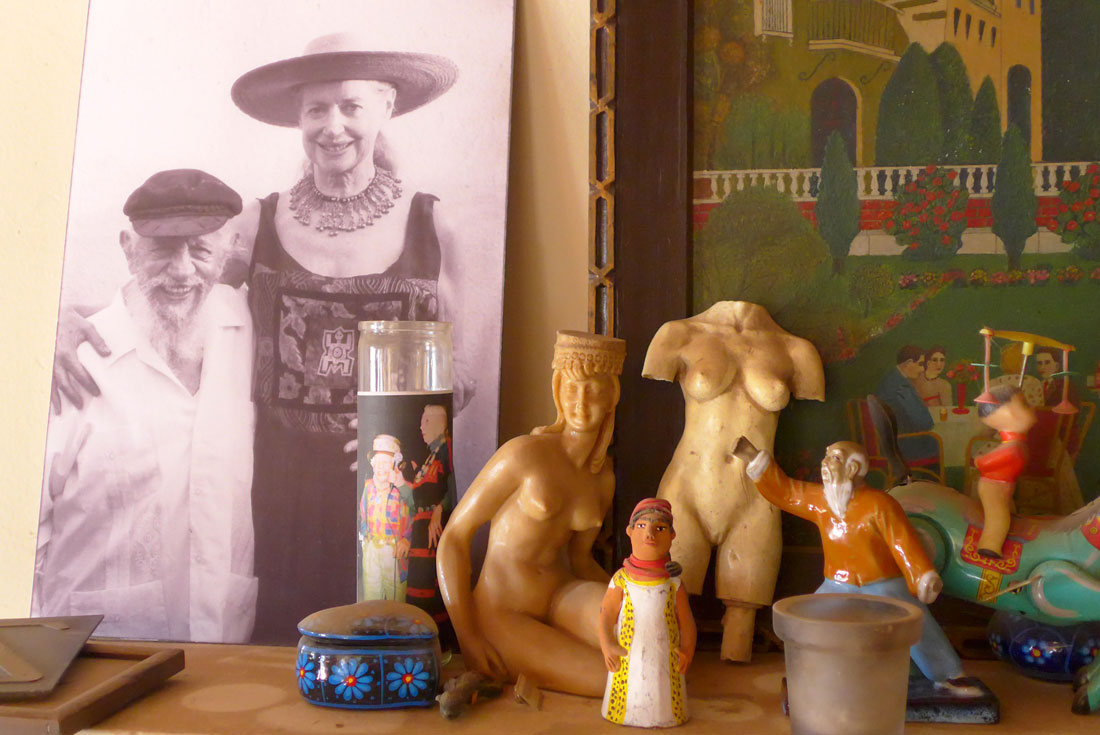
Jirayr and wife Dabney displayed on the mantle in the Zor-house.
By Hans Allhoff
We could all travel less and burrow into our own backyards more. Stay home, go deep, practice monogamy of place. Don’t be that person who’s just heard of the Zorthian Ranch. Be someone who’s been.
You can look down on the Ranch from high on Chaney Trail or Mount Lowe Road, and glimpse why a Star News writer called it a “trash-strewn hilltop.” Not entirely unfair: Jirayr Zorthian could be accused of razing healthy orchards and amassing non-op cars, industrial waste, and construction debris–in service to his art, of course.
But should that matter, if it didn’t matter to the marvelous cast of characters the Ranch drew? L.A. bohemians, Andy Warhol, JPL intellectuals, art luminaries, Bob Dylan, John Lautner, the jazzman Charlie Parker, and most legendary, the Nobel Laureate Richard Feynman.
Zorthian was an Armenian who fled the genocide as a boy, and landed on some Altadena acreage in 1946 by way of Yale School of Art, Europe, FDR’s WPA, and the United States Army. As a GI he worked in intelligence and painted his mural masterpiece The Phantasmagoria of Military Intelligence Training. The whereabouts of the 4 x 157 foot mural are unknown, but a since-covered wall at the Pentagon isn’t out of the question. A digitized version spans the wall of an AirBnB on the Ranch.
Today, the Ranch comprises 40 acres that’s home to Jirayr’s son Alan (a long-time AH board member), a number of docents, and experiments in the following: permaculture and agriculture, all kinds of art, animal husbandry, assemblage architecture, and living resourcefully. A modern economy and permit-policing state aren’t kind to places like the Ranch. But admirably, if imperfectly, it endures — and the next generation, including Alan’s daughters Caroline and Julia, are making their own wonderful imprints.
Alan worked for years after his father’s death in 2004, and still works, to clear away the accumulated detritus that has irked County health and other officials. That is its own artistic practice and challenge. Why scrap the old handpainted Zor Bus, or a classic car, if there’s a chance it can be made to run?
Visually, the Ranch remains funky — more reclusive Topanga, you might think, than beautiful Altadena. There is a pool with a view, but it won’t make your vision board if you typically source from Dwell and Architecture Digest. The ascent is precarious, if you prefer your roads graded and your bridges sturdy, but you forget all that at the top. Welcome to what Zorthian himself called “The Center for Research and Development of Industrial Discards with Emphasis on Aesthetics.” Alan jokes his dad always said he needed 40 more years to get the Ranch right. La Sagrada Familia de Altadena.
The Ranch belongs here all the same, though, because it stands for the same thing Altadena stands for, namely, the primacy of place in our happiness and freedom. Counter-cultural, sure, but not antagonistically so. You can’t just show up at the Ranch, but if something is happening–and something usually is happening–everyone is welcome.
But back to the man. The wild man.
“Jerry” was Dionysian and unpretentious in his worldview, but a Yale man, millimeters removed from Skull and Bones. Knowing that Jerry and Richard Feynman were dear friends, trading lessons in physics and art for years, I like to imagine how a meeting between the artist and William F. Buckley, his fellow alumnus, would have gone. Would WFB have threatened to “sock him in the goddamn face,” as he did Gore Vidal? This would have ended poorly: Jerry was 5’3 but a ferocious and decorated wrestler.
Zorthian was a witness not only to genocide but to the death of his own 18-month old son, whom he accidentally, tragically, backed over in his van. Yet he came out on the other side with a life oriented to experimentation and play. He often painted nudes and in later years famously hosted a birthday party every spring in which he, calling himself Zor-Bacchus, sat on a throne as nude women danced around him.
He was a trained artist, but uninterested in the art world or the art business. He studied Michaelangelo and da Vinci while in Europe, and wanted to be broadly talented like them. It was always the Ranch, not any piece or portfolio of art, that was Jerry’s lifeline and justification.
Zorthian’s art does hang at the Ranch, of course — a portrait of Miss October 1963 Christine Williams is in the Ranch’s version of a gift shop (and photos of Zorthian painting it in Playboy’s October 1963 issue). Across the room is a massive painting, The Divorcement, depicting the disintegration of his first marriage. That wife, Betty Williams, served him with papers upon his return from Syria attending to the death of his father. As Alan tells it, she’d been in Pasadena, falling in with Jack Parsons, L. Ron Hubbard, and Alistair Crowley. In the divorce, she got the kids and he the land. His second marriage, to his enduring muse Dabney (and Alan’s mother), lasted until his death.
The Feynman friendship left an artistic footprint, too. There is the Feynman Wall of Passion, a stone and brick wall inlaid with found objects that frames a small sanctuary. Across the way, a metal sculpture approximately the size of an RV represents the collision and harmony of their respective fields.
But it feels like the art isn’t the main point of the Ranch. It’s the built environment—almost all of it by the hands of Ranch-dwellers themselves. It is habitable, and that’s just fine: it may even be what the Ranch sees as one of its defining virtues. If you’re trying to serve up an alternative vision of how to live, and what to live for, construction details are decidedly not the point. It is telling that Jerry considered the Boy Scouts of his youth as formative to his design philosophy as Yale.
About the jazzman’s visit: “Charlie Parker at Jirayr Zorthian’s Ranch, July 14, 1952,” is not easy listening. It exists because someone on the property happened to have a reel-to-reel tape recorder: the liner notes say “the sound quality is inevitably bad.” But that is not an apology, because what you’re listening to is less a concert than a night in time. The story of their meeting and the night is told in comic–book form in Chasin’ the Bird: A Charlie Parker Graphic Novel.
The Ranch is pure Jerry. But emerging from it, rolling back down to Loma Alta, the poet Gary Snyder comes to mind: “Find your place on the planet, dig in, and take responsibility from there.” Alan told me that when his dad came to southern California, he first looked at La Jolla. Let’s celebrate that this beautiful person found Altadena and dug in here instead.